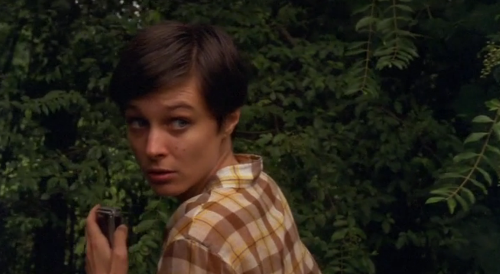
Thursday, 18 February 2021

Kikujiro | Takeshi Kitano, 1999

Kikujiro | Takeshi Kitano, 1999

Originally published 20th March 2015 on my Tumblr. I'm moving some old writing from there over here because it's nice to have it all in one place. It's also nice to look back once in a while.

A lonely young boy, Masao, wants to track down his absent mother during one summer, but he has no way of making the 200 mile journey to where he thinks she lives alone. A friend of his grandmother's forces her husband, Kikujiro, to accompany him, and the two head off on an eventful trip to find her, somehow involving violence, hitchhiking, gambling, theft, criminal damage, and more. The severity of these situations is never fully addressed, only implied: a bloody nose is the only evidence of a brutal beating, and their huge gambling losses are offset by the game they play to decide which riders to bet on. Both characters are living these moments together, so it makes sense to see both sides, and Kitano constantly shifts perspectives between the naive Masao and the hardened Kikujiro for the sake of a polyphonic account. Youth downplays the danger while maturity heightens the threat.

Yet as their relationship develops, the perspective becomes universal. Masao, once sad and alone, is visibly happier, even when the point of his journey dissolves in front of his eyes, and Kikijuro's brash attitude eventually softens, and his rudeness becomes playful and endearing. The unlikely duo have brought out the best in each other, simply by being together, and although the trip didn't work out as they'd hoped, they gained more than they could ever have imagined. On the last night before they return home to Tokyo, Masao looks up at the stars. Hidden in constellations are the wonderful memories of his summer, his first as part of a family, all the fun he had seared into the sky, burning bright, there forever. It’s joyous.

Bitter Victory | Nicholas Ray, 1957


Bitter Victory | Nicholas Ray, 1957

Originally published 15th February 2015 on my Tumblr. I'm moving some old writing from there over here because it's nice to have it all in one place. It's also nice to look back once in a while.

The cinema of Nicholas Ray is filled with characters navigating morally ambiguous worlds they don't seem to fit into: A teenager is overwhelmed by adult responsibility when a kid from his town is killed in Rebel Without A Cause; A businesswoman waiting for a new railroad to make her rich faces violent opposition from the bloodthirsty locals in Johnny Guitar. In Bitter Victory, a squad of soldiers have to decide whether they can live with the consequences of their actions when the rules of war are undefined. The answer, of course, is invariably no. After all, they're only human.

The film shows three stages of a top-secret military operation in North Africa during World War II: the planning, in which a general interviews two officers, Brand and Leith, for the opportunity to lead the operation; the operation itself, as the soldiers parachute behind enemy lines to steal crucial documents from the Nazis; and the aftermath, as the soldiers travel across the desert back to base. Leith is a soldier by circumstance. A volunteer to the war effort, he's an archaeologist with a deep understanding of both the surrounding terrain and its language; Brand, on the other hand, is a professional soldier with fifteen years service, more suited to leading men than Leith but less at ease in the desert. The two men are chosen for the mission, but Brand is put in charge. What follows is a straightforward (if treacherous) plan gone awry, first as a Nazi patrol intercepts the soldiers' transport, forcing them to walk miles back across the desert, then by Brand and Leith's increasingly fractious relationship, the fires of which are fuelled by past lovers, a potentially career-ending act of cowardice, and opposing personal codes of ethics.

Ray illustrates the moral differences between the two soldiers by placing them in situations in which they have to make a life or death decision: Leith is faced with the task of killing two mortally wounded men to ease their suffering, while Brand sees a scorpion inching towards an unaware Leith as he rests. Ray places each thought process under the same scrutiny, cutting between each man's perspective of the situation and their reaction to it as it unfolds. Brand watches the scorpion's approach and fails to act, knowing its sting could solve his problems by killing the only witness to his earlier act of cowardice, and Leith watches the men writhe in agony and decides to act, saving them from their pain by taking their lives.

But these decisions, no matter the intention, are ultimately both soldiers' downfall. Killing is "what makes a soldier but destroys you as a man," as Leith says, whether it's an act of mercy or a calculated act of malice. And men are destroyed. Before the mission, Brand and Leith are, at least outwardly, normal soldiers: Leith is cocky and sarcastic but eager to lead the operation, while Brand is more reserved and dutiful, but acts like a boy when he hears his wife has arrived. After the mission, however, their characters are vastly different, broken by the consequences of their decisions. They've both become murderers, and for what? The documents they fought so hard for seem to have no real significance, and the war is barely even acknowledged, with only the rare sound of planes overhead and the occasional Nazi patrol vehicle to suggest that it's even happening.

As the soldiers return from this trivial task in an almost incidental war, Ray frames them against the vast, endless vistas of the desert (shot in black and white CinemaScope, a complete turnaround following the vivid Technicolor of Hot Blood), their diminutive presence in the expanse of the sand dunes equal to that of their mission. These men kill for nothing and die for nothing. Bitter Victory isn't about what there is to gain from war, but what there is to lose.

Cure | Kiyoshi Kurosawa, 1997

Cure | Kiyoshi Kurosawa, 1997

Originally published 19th January 2015 on my Tumblr. I'm moving some old writing from there over here because it's nice to have it all in one place. It's also nice to look back once in a while.

The world of Kiyoshi Kurosawa's Cure is a blank space. Almost entirely interior, the rooms occupied by the unlucky characters are uncluttered and bare, painted off-white and meticulously organised. Posters, the few there are, are geometrically pinned to walls, while the desks and shelves boast small filing cabinets and folders. The only unregimented space in the film belongs to its antagonist, amnesiac drifter Mamiya, whose apartment is littered with books on personality disorders, mesmerism, and psychoanalysis, six month old leftovers and the decomposing corpse of a monkey, tied to a pipe with its arms and legs folded across its body.

Mamiya is manipulating people, who he meets in seemingly chance encounters, into murdering somebody close to them through a form of hypnotisation. His methods are shown in long, mostly static sequences but never explained, and his motivation is never addressed. His odd presence in scenes, nonchalantly luring his victims in conversational circles before stunning them with the flame from his lighter or the slow trickle of a spilt glass of water, stands out immediately as something that shouldn't be there: in his first scene, he suddenly appears on a beach; later, he appears on the roof of a building.

His abrupt appearances make no logical sense, but Kurosawa seems more interested in the idea of how a man like this can exist in such a calm world than trying to explain his actions. Mamiya shows no empathy when his experiments turn people into murderers, as if he's testing his abilities on lab rats, not human beings, and, as the police finally work out who he is, the revelation of his solitary existence suggests a disconnect from both society and basic human interaction — which, in Kurosawa's cinema, is the root of all evil.

They All Lie | Matías Piñeiro, 2009

They All Lie | Matías Piñeiro, 2009

Originally published 1st September 2014 on my Tumblr. I'm moving some old writing from there over here because it's nice to have it all in one place. It's also nice to look back once in a while.

The premise of Matías Piñeiro's They All Lie is deceptively simple: a group of young people move to the Argentinean countryside to pursue various artistic and pseudo-criminal endeavours. A woman paints copies of her ex-boyfriend's work as part of a forgery scheme; another dictates a novel for someone else to write; a man learns a song on his guitar. Piñeiro captures these relatively mundane events, as well as the surreptitious interactions between the group's members, from a distance, moving his camera gracefully around their house as his increasingly complex narrative games unfold. Do they mean anything? Who can say for sure, particularly after one viewing, but the mounting feeling of paranoia and the mastery with which it is all presented is undeniable — even if the results are, at least for now, frustratingly ambiguous.

Sunday, 7 February 2021

Housekeeping | Bill Forsyth, 1987


Housekeeping | Bill Forsyth, 1987

The long-awaited arrival of Aunt Sylvie takes her two nieces by surprise. Outside in the garden, Lucille and Ruth build a snowman and see a woman walk towards the house. Apprehensive about their new relative, a stranger to them like much of their family, the two sisters head inside and join their aunt at the kitchen table. Lucille is wearing a red cable-knit jumper and Ruth is wearing a blue one. Aunt Sylvie removes her coat to reveal an emerald green dress, and the three of them sit together for dinner. One red, one blue, and one green. Three complementary colours, but colours not entirely at ease. The primary red and blue sit at odds with the secondary green, an outlier in this relationship, and one that suggests the absence of a yellow that must’ve been here before. The absence lingers, and the girls enthusiastically ask Aunt Sylvie to tell them stories about their mother. “It’s hard to describe someone you know so well”. The chasm of the missing yellow can never be filled by the green.

Sunday, 31 January 2021

Body Double | Brian De Palma, 1984


Body Double | Brian De Palma, 1984

Jake, a struggling actor, suffers a claustrophobic panic attack during a film shoot and is given the afternoon off to recover. He stops at a hot dog stand to pick up food for him and his girlfriend and, beaming ear-to-ear on a sunny LA afternoon, drives home. He bounds into the house and unloads the hot dogs on the table, placing them next to a custom-made neon light that illuminates the words “Jake ❤️Carol”. He hears a woman’s laughter from somewhere deep in the house, and he goes to find its source. A photo frame shows a woman, presumably Carol, Jake and a small dog posing together, Carol pulling at the dog’s ears. As Jake walks through the shadowy corridor, De Palma cuts between close-ups of his inquisitive face as he searches for Carol, and Jake’s POV as he enters each room, sharply rounding corners of doorways as if expecting to find her giggling alone in the kitchen or the spare room. As he reaches the bedroom, the last unchecked room in the house, the laughs have turned into moans. He opens the door and sees Carol having sex with another man. She’s on top of him, and doesn’t get off him when she sees Jake. She just looks down at the man beneath her, then defiantly back at Jake. He sheepishly backs out of the room, closing the door behind him.

Later, Jake lies to Sam, a friend of a friend, about what he saw. “Christ, I keep seeing it, Carol lying there. Her face was glowing.” Except that’s not how he found her. She wasn’t lying anywhere. She was on top and the man was lying down. This wasn’t a one-off slip of judgement. This wasn’t a mistake, or something to regret. She chose to have sex with someone else. She decided that this was something she wanted and, once she was discovered, made it clear to Jake that she had nothing to apologise for. This is a low-stakes lie for Jake to tell. Sam is essentially a stranger, but Jake still feels inclined to tell the story this way. Maybe it’s easier for him to imagine Carol as someone who’d be dominated by another man than as someone with sexual desires that he couldn’t keep up with. On a day in which his impotence both as an actor and a man have been exposed, perhaps this lie is his first step to reclaiming some semblance of perceived masculinity, that by pretending his girlfriend was underneath someone else rather than on top he can process the pain of losing the woman he loves more easily. Perhaps this version of events wounds him less fatally.

This lie is such a perfect De Palma moment. An event shown subjectively through the POV of a witness, and objectively through close-ups that serve to confirm its veracity, while later having the same witness provide an alternate account of events, one that they can’t possibly have misconstrued, that exposes the brittle male ego of a man trying to control his own narrative. The entirety of Body Double in microcosm, and a fascinating precursor to the events that follow.

Monday, 28 December 2020

Letterboxd Reviews #2

Another collection of brief capsule reviews, written between March 2019 and May 2020, all taken from my Letterboxd and all slightly revised after re-reading them with fresh eyes. I like them all, and I like having them all in one place. Please enjoy.

Canyon Passage | Jacques Tourneur, 1946

The destruction of red forests by white men: banal at first and, finally, predatory — a gradual descent into hell, predicted by red leaves and skies, driving rain and broken glass, as a close-knit community falls apart in stages: a man with tree-trunk arms menaces from the sidelines; a forbidden romance bubbles under, then over; gambling debts allowed to spiral cause a murder; sixty men ride to fight back after one of their own provokes a dozen-or-so Indians into a retributive attack. Individual violence becomes societal. A close-up of a gleeful Susan Hayward at the front of a crowd watching as Dana Andrews beats the shit out of Ward Bond in a bar fight. There's safety in violence for the people of this town, and this violence ignites a romance — so it's hard not to read the ending as a warning of doom to come. Pent up desires become reality in the chaos of battle, a path to happiness is cleared in the debris. Ride on to a new life in a new town.

The Dead Don't Die | Jim Jarmusch, 2019

The end of the world as a product of baby-boomer America. An apocalypse viewed from an old-fashioned small town, built and maintained by an old guard whose elders all cling to memories of one another from their youth, but keep the generations after theirs at a distance. Adam Driver's say-it-as-he-sees-it deputy questions the logic of why kids are buried in a separate section of the cemetery to the adults, a concern that Murray's old-timer police chief (who should've retired two years ago) bluntly dismisses as a product of its time and changes the subject. Selena Gomez and her hipster friends pass through in town on a road trip and are left to die in a motel, while three teenagers, locked for unknown reasons in the town's excessively large young offenders prison, escape into the darkness, never to be seen again. The past will destroy the future, the old have destroyed the young. "I've read the script".

Dracula | Terence Fisher, 1958

Centuries of loneliness. There are no portraits in Dracula’s castle; no signs of life, past or present. The stony walls are lined instead by medieval weapons and trophy heads. A history of violence, but no heritage. The cavernous castle is nothing but a succession of spaces waiting to be filled, its unmoored owner unable to make use of it. There are monsters all across Fisher’s cinema, human or otherwise, and Christopher Lee’s looming menace lends itself beautifully: his Dracula a vast shadow of a man reduced to a predatory carnality, at once both an alluring romantic and a horrifying creature. Peter Cushing’s Van Helsing, the intellectual counterpoint to Dracula’s sensuality, is the only viable resistance to the vampire, and Fisher gradually sets up a typically one-sided confrontation between human and non-human, living and dead. But this inevitable moment of triumph for humanity passes, and it’s the tragedy of the vampire that lingers. Cushing, alone, looks over what’s left of Dracula’s body in pensive silence, and Fisher closes the film on a close-up of a ring among the ashes: a discarded relic that should be an heirloom, but nobody around to claim it.

Gangs of New York | Martin Scorsese, 2002

"The blood stays on the blade", and it does. The past has great sway over these men and their actions. History must be kept alive to justify the choices of the present, but all that exists in this history is violence. Battle scars and grudges, notches on clubs and glass eyes. Violence as a way to claim and consolidate power, and to validate a poisonous belief system. The challenge finally comes not against the beliefs but against the leader — so nothing changes. It's just another violent chapter in this history. Time passes and vendettas are forgotten, buried beneath the ground of an abandoned, overgrown graveyard. The blood stays on the blade, sure, but the knife is lost to history.

Grass | Hong Sang-soo, 2018

Like the rows of plant pots that bookend it, this is very much a film of controlling nature. A portrait of a writer's attempts to create, observe and inflect upon human interactions in a quiet coffee shop as a way to navigate, escape, and make sense of her own problems. It's never entirely clear how much Kim Min-hee is authoring the on-screen events, if at all, and single lines of dialogue seem to undo any presumed comprehension of previous detours ("you've been here all day") but, whether reality or invention, or a straddled line between both, the goal of these observations is to find a way to parse emotional turmoil rationally. A film of disparate elements slowly coming together in harmony, and Hong ties them all together with a simple gesture that hints at a breakthrough and a return to normality — it's good to eavesdrop, but it's always better to drink and talk.

Kill, Baby... Kill! | Mario Bava, 1966

A nightmare in ruin. A medieval village exists in near-dilapidation and foggy silence, its residents plagued by fears of the vengeful spirit they believe to be responsible for a series of bloody deaths. A doctor, whose rationality sits at odds with the spirituality of the villagers, arrives from a faraway town to perform an autopsy on the latest victim, and it’s through these practical eyes that Bava views the curse that lingers over this place. The initially explainable bumps in the night soon become harder to define: a church bell ringing of its own volition could be caused by the wind, but meeting and talking to a young girl who apparently died twenty years earlier is more difficult to make sense of. Bava revels in these impossibilities, pushing the doctor’s logical reasoning to its limits with increasingly nightmarish imagery (time-loops, doppelgängers, creepy dolls), yet as the doctor gets closer to the history of this place he begins to uncover its despondency: the pristinely maintained bedroom of a young girl, locked and kept exactly as it was on the day she died by her mother, and the ruinous state of the village itself. A nightmare in ruin, resigned to slowly crumble away in anguish.

Red Sorghum | Zhang Yimou, 1988

A sledgehammer-blow of a movie. Every action is a power-play (pissing in the wine, shutting a door, faking a bow) that shifts and deepens a relationship, whether romantic, antagonistic, or otherwise, until, suddenly, everything changes, and these relationships and their histories are re-contextualised by war. A love-song blows with the wind through burning fields, a child weeps for his mother in a bomb crater. The beauty of this place is destroyed in the fire. Everything turns red in the end.

Shark | Sam Fuller, 1969

A truly grotesque spectacle, in which people kill for money and sharks kill for blood. Fuller forces his characters down and away from each other by dividing shots with ceiling fans, fences, beaded curtains, wooden beams, watching as people dance around each other trying to gain trust while their own schemes evolve on the fly. Always oppositional, always oppressive, always dangerous. The second anyone dives down, Fuller cuts to a shark. There's no such thing as safety.

Shock Corridor | Sam Fuller, 1963

An amazing indictment of journalism, in which editorial meetings are held under the same portraits as in Park Row but with none of the nobility that those men supposedly traded in — the goal now is sensationalisation. There's not much of a story in the murder itself but rather in its setting, an easy way to stoke fears of psychiatric treatment. If anything, the real scoop is in the witnesses to this murder, three men destroyed by homegrown monstrosities (brainwashed POWs returning home, violent racism and the rise of the KKK, the creation of nuclear weapons) and abandoned by their country, but that, presumably, doesn't sell newspapers anymore. "We're right on the brink of a disaster". What good is a journalist with nothing to say?

Thursday, 24 December 2020

2020 in Cinema

A colander hits the floor in Steve McQueen’s Mangrove, the first part of his Small Axe project. The colander, along with many other utensils, has fallen from its place in the kitchen of The Mangrove, a Caribbean restaurant in Notting Hill, following one of many police raids to occur on the premises, starting in the late 1960s into the 70s and beyond. As the owner, Frank Crichlow, is pinned down and racially abused by an officer, McQueen cuts to a low angle from the kitchen floor as several officers charge out of the restaurant, while the colander ceaselessly rocks back and forth on its side. When McQueen finally cuts away, after around 35 seconds, the colander is still in motion. A community holding firm against violence, and the violence that continues long after the commotion has ended.

McQueen fills Small Axe with these kinds of declaratory, summarising images. Lovers Rock is centred around an uninterrupted but necessarily private a cappella rendition of Janet Kay’s Silly Games at a house party. A flock of starlings twists and turns its way back and forth across the sky above an industrial estate in Red, White & Blue, an image of coordinated movement stemming from thousands of years of evolution that hits particularly hard in this study of a black police officer fighting against the deep-rooted prejudices ingrained within the Metropolitan Police. In Alex Wheatle, a young Black schoolboy is straightjacketed, racially abused, and thrown to the floor of an empty school hall by two White teachers after a classmate goads him with monkey chants, and in Education, a young boy, abandoned by his teachers and sent to a “special” school against his wishes, lays forlornly in a bathtub, hopelessly staring at the ceiling, lost in thought after yet another structureless day. 

McQueen shoots each of these moments, as he has done so frequently throughout his career, in unbroken long takes, and duration has been a key element of his cinema since Hunger. McQueen tends to offer these extended moments of reflection as a way to underline key images and ideas in his work and illustrate the challenges faced by his characters. In Hunger a conversation in which a priest tries to talk Bobby Sands out of his hunger strike, shot in one 17 minute take, fails to change his resolve in a situation that, to Sands, cannot be changed out of political necessity, and in Shame, the ambiguity of the film’s ending undercuts Brandon’s emotional breakdown, brutally depicted in a rain-soaked, isolated mid-shot at the end of a pier, by presenting a world that will always be filled with temptation without showing whether he succumbs to it or not. 

From 12 Years a Slave onwards, however, this approach changes, and McQueen shifts away from inescapability and begins to use long takes as a way to illustrate something more akin to qualified optimism. Solomon Northup, robbed of so much time and treated like an animal for more than a decade after being abducted and sold into slavery, is frequently subjected to, or witness of, dehumanising acts of violence presented in unflinching, extended detail, finally finds some justice in the world and returns to his family, all of whom have aged almost beyond his recognition. In Widows, the socio-economic disparity and the moral vacuum within political institutions that create such conditions, vividly demonstrated by an extended shot of a local politician privately berating his constituents as he’s driven to his gated home, may have endured another election, but each of the “widows” are finally able to claim independence on their own terms and build a better life for both themselves and the wider community. McQueen highlights the extraordinary challenges faced by his characters in these long takes, before showing the same characters rising up against these challenges as time passes. Tributaries to the river of systemic change.

And the same can be said of Small Axe. The Mangrove Nine successfully expose the racism of the police and are acquitted in court. Two lovers cycle freely around London in the early morning sun. A father and son reunite and raise a glass to a brighter future. Alex Wheatle is released from prison and sets out to write a book and find his family. A young boy slowly and enthusiastically reads aloud at the dinner table after finally being taught how to at Saturday school. McQueen never minimises or shies away from the challenges faced by the West Indian community in London, challenges that absolutely remain to this day, but these are not films about hopelessness. There is nothing that cannot be changed given time.

It’s quite frankly extraordinary that Small Axe exists. The idea that a filmmaker like Steve McQueen can make five feature-length works about Black life in Britain, that celebrate West Indian culture and confront the racism that exists within the UK, and have them broadcast on the BBC once a week for five weeks is a miracle, and one particularly important in 2020. Television guarantees an audience for works such as this that cinemas cannot even hope to replicate, even in more normal circumstances, and all five episodes of Small Axe were viewed by more than a million people each during their first broadcast¹. I don’t know if we’ve ever needed art as much as we do right now, and it’s an incredible thing to have free national access to such strong and forceful work from one of the leading British artists of the 21st Century. I really hope we see more of this kind of thing in 2021. Art seems to be the only thing right-wing Governments are afraid of. It might be the only way to change anything.

On a personal note, I’ve been lucky in many ways this year. I’m doing fine, and the horrors of this virus have for the most part evaded me so far. I’ve spent much of my time indoors, traveling vicariously by watching Anthony Bourdain’s Parts Unknown from start to finish on Netflix and buying indie travel journals on Instagram. I’ve been digging into filmmakers like Ringo Lam, Nobuhiko Obayashi, and Budd Boetticher, among others, whose works I had never previously seen and knew only by reputation. I’ve also been watching the films of Alan Clarke, another British filmmaker who found a home for his work on the BBC, whose eviscerations of Tory Britain still remain relevant in a year in which the Government voted not to provide meals for children living in poverty in the midst of a public health crisis. Elsewhere, I’ve been running more than ever, and if circumstances allow me to do so I’ll be running my first half-marathon in April for the British Heart Foundation. I’ve also entered the ballot for the London Marathon, which may or may not be something that I’ll live to regret in the coming months. I’ve been listening to Phoebe Bridgers and Mac Miller, Waxahatchee and Fiona Apple, Yaeji and Lawrence Lek. I didn’t watch Contagion.

As of late November, I started watching five new-to-me Vincente Minnelli melodramas over five consecutive Sunday afternoons as a way to bring some joy to the long winter nights stuck inside, building towards an end-of-year re-watch of Brigadoon, maybe the most beautiful of all films. It feels important to end this year, a year of far too much death, of too many panic-stricken news reports and evasive press conferences, on a note of positivity, and I’m sure that Gene Kelly running back through the Scottish fog to Cyd Charisse will deliver something close to that. The idea of cinema as an escape from the fog has never felt more necessary yet more out of reach. I hope, for all our sakes, that reality becomes more palatable in 2021.

In alphabetical order:

Da 5 Bloods | Spike Lee
Days | Tsai Ming Liang
The History of the Seattle Mariners | Jon Bois & Alex Rubenstein
The Invisible Man | Leigh Whannell
Isabella | Matias Pineiro
Never, Rarely, Sometimes, Always | Eliza Hittman
On The Rocks | Sofia Coppola
Siberia | Abel Ferrara
Small Axe | Steve McQueen
Tenet | Christopher Nolan
Undine | Christian Petzold
The Woman Who Ran | Hong Sang-soo
_________

My top twelve of the year is painfully English-language focused, and I don’t know whether I have an excuse for that.  I don’t think I’ve been as discerning as I’d like to be over the past few years or so, nor do I think I’ve been as interesting. I was reading a recent newsletter by Kelley Dong, a wonderful critic, about, among other things, their relationship with the films of Kim Ki-duk, who recently died from coronavirus while living in exile following multiple allegations of rape and assault. Dong writes: “Some might know that Kim was the reason that I became interested in film criticism. When first confronted with his films, I was extremely skeptical. But I was also overwhelmed with an obligation to cross that bridge from being a fan or detractor to a critic of an artist whose films stirred me as much as they upset me.” I feel as if I’m very much still on this bridge with regards to cinema, but I’m further than ever from being able to cross it. I mostly stopped writing notes at some point in mid-2019, and I don’t really write criticism anymore. Back when I did, I always tried to decipher the significance of a specific object or image within the context of a piece of work, as a means of giving an indirect sense of the whole thing — an approach best exemplified by my favourite piece of my own writing, on Brian de Palma’s Femme Fatale.

I used to enjoy writing in this way, and I still think it’s a process that yields interesting results, but lately I’ve not been going as far as I used to. I’m still finding exciting and stimulating films to watch, but I seem to have unknowingly settled for the pleasant recognition of the strange patterns and symbolic objects that, until recently, I used as a starting point. This personal limitation has only been compounded by my burgeoning interest in genre cinema, where the structures and politics are more a part of the surface. It’s easy to look at, for example, a film like Ringo Lam’s City on Fire, a great film, and broadly understand its ideas without having to do too much heavy lifting, but there’s so much more to engage with in that film than the turbulence of its emotional gymnastics and the brutality of its action. I know there’s more there, and I do usually get a sense of it, but I’m not doing the work to push further and find it. I feel as if I’m becoming a passive spectator out of laziness, more than anything else, and I’d like to think this can be changed. I know it’s a matter of effort and desire, and perhaps finding these things again will be something I work towards next year. I don’t want to just sit and watch anymore. It’s not enough. One way or another, I have to cross the bridge.
_________

Ten discoveries from a year lived indoors. I’ve never been in a position to share a fifty film longlist before, yet here we are. I hope I see fewer films next year.

Full Alert | Ringo Lam, 1997
Strange Days | Kathryn Bigelow, 1995
The Cobweb | Vincente Minnelli, 1955
Anne of the Indies | Jacques Tourneur, 1951
Road | Alan Clarke, 1987
Made in Hong Kong | Fruit Chan, 1997
Boat People | Ann Hui, 1982
Le Boucher | Claude Chabrol, 1970
Fat Girl | Catherine Breillat, 2001
His Motorbike, Her Island | Nobuhiko Obayashi, 1986
_________

Some highlights: 1) In Rotterdam, stumbling across a gorgeous exhibition of Robby Müller polaroids on a chilly Sunday afternoon in January after walking around aimlessly for hours, taking photos on a disposable camera that I’ve not been able to have developed. 2) In Berlin, hearing the words “Treptower Park” read out over the automated announcements on the S-Bahn from the airport into town, a station I’ve never actually been to but one whose name has ignited something undefinable within me each and every time I’ve passed through it. 3) The absolute horror that I and everyone else in the room felt simultaneously during the restaurant scene in The Invisible Man, one of the most beautifully executed shocks I’ve seen in years and the last filmgoing experience I had before lockdown. 4) Beginning to make a concerted effort to improve myself physically and mentally in my free time. Both remain works in progress, and perhaps they always will do, but after spending the majority of my fading twenties in stasis, it feels nice to be active for a change. 5) And, finally, watching seventeen bombastic thrillers of some form or other with friends in the group chat during the depths of lockdown, a genuinely joyful and revitalising communal experience in a sparse year for such things.

Be well in 2021.

¹ viewing figures taken from Broadcast

Tuesday, 24 December 2019

2019 in Cinema

"I'll be waiting for you on the beach. Come and find me."

I’ve been thinking a lot about history this year and, in the process of looking back over the previous iterations of this annual write-up (2016, 2017 & 2018), it’s apparent to me that this has always been the case. The things I seem to gravitate towards, or at least the things that are on my mind most often, are all rooted in the idea of lost histories, or the void that remains when the past disappears. This year, especially, I’ve been thinking a lot about how it’s becoming far too easy to forget the lessons of our history. I’ve been thinking about George A. Romero’s Day of the Dead, which I saw for the first time in the summer, and how its survivors are forced underground, surrounded by all the records of an irretrievable past, and left to rebuild the society they’ve lost. In this bunker, cut off from everyone and everything, it’s left to them to find a cure to the plague of zombies that amble above their heads and find the best way to move forwards. Should we fight to ensure we hold on to our history, learn from it and build something better from the ashes, or should we take the loss, start afresh somewhere new and bury the past underground with the zombies? I’ve been thinking about Pedro Costa’s Vitalina Varela, and about how a life's worth of time can be lost by holding onto dreams of futures that were never going to pan out. I’ve been thinking about Martin Scorsese’s The Irishman, and how people are defined not by what they do in their lives, but by what they leave behind. I’ve been thinking about Kleber Mendonça Filho and Juliano Dornelles’ Bacurau, and how a dysfunctional community is a better weapon against the horrors of our world than a divided one.

I’ve been thinking about Death Stranding, and how Hideo Kojima has developed a game in which the simple act of traversal is beneficial to other players around the world. To cross a fast-flowing river, for example, a player can lay a retractable ladder from bank to bank and walk across, and then collect it and carry on their journey. However, if the ladder is left behind, it can be encountered in the same place in the games of other players, and can be used to easily cross the same river without that player having to expend their own resources. The game’s numerous delivery missions are arduous and attritional, and it’s difficult to maintain balance on even flat terrain with a backpack stacked high with boxes, let alone to climb vast, snow-covered mountains or deal with the many threats that lurk in these seemingly empty landscapes. To encounter a ladder laid across a river by another player is a welcome sight. In my playthrough, I always left things behind for players who would encounter an area after I did, and I always found use of the things left by other players who had already passed through. Kindness is encouraged and rewarded in Death Stranding, and, more than anything else this year, I’ve been thinking about how rare it is to find this. And how beautiful.

This year has been the hardest of my life. I hope I can take something beautiful with me into the next.
__________

In alphabetical order:

Bacurau | Kleber Mendonca Filho + Juliano Dornelles
The Irishman | Martin Scorsese
I Was At Home, But… | Angela Schanelec
Martin Eden | Pietro Marcello
Monsoon | Hong Khao
Parasite | Bong Joon-ho
So Long, My Son | Wang Xiaoshuai
The Souvenir | Joanna Hogg
Tamaran Hill | Tadasuke Kotani
To The Ends of the Earth | Kiyoshi Kurosawa
Uncut Gems | Josh & Benny Safdie
Vitalina Varela | Pedro Costa
__________

Some highlights.

In February, enjoying a gushing conversation about the work of Angela Schanelec with Alex and Hind after a screening of My Sister’s Good Fortune in Berlin within earshot of the director herself who, unbeknownst to me, had been standing less than five feet away from us the whole time. In April, watching Tsai Ming-liang’s The Deserted VR in London with Dan and having my whole perception of cinema changed in 55 minutes. In July, exploring Marseille with Chris and getting caught in the maelstrom of irrepressible city-wide celebrations following Riyad Mahrez's 94th minute winner for Algeria in the semi-final of the African Cup of Nations. In October, experiencing the pure cinephilic thrill of being in the presence of Martin Scorsese as he introduced a screening of The Irishman.
______

Ten discoveries from a limited year. I'd like to think the next will reap more rewards.

Day of the Dead | George A. Romero, 1985
Canyon Passage | Jacques Tourneur, 1946
Memories of Murder | Bong Joon-ho, 2003
Gangs of New York | Martin Scorsese, 2002
Street of No Return | Sam Fuller, 1989
My Sister’s Good Fortune | Angela Schanelec, 1995
Kotoko | Shin’ya Tsukamoto, 2011
The Invincibles | Dominik Graf, 1994
Blood and Black Lace | Mario Bava, 1964
The Gorgon | Terence Fisher, 1964
______

I’ve seen too much death this year.
In 2020, we’re living.

Wednesday, 2 October 2019

LFF 2019 #1 | End of the Century, Love Me Tender

London Film Festival 2019 | #1

“I feel that we’ve met before”. A simple observation from one man to another ignites Lucio Castro’s End of the Century. Ocho, an Argentinean poet-slash-airline-marketer from New York arrives at an AirBnB in Barcelona to spend a few days exploring the city on his own, wordlessly walking the peaceful streets and taking photos with his iPhone. He goes to the beach and watches a man stand up from his towel and head to the shoreline. Attracted to him, Ocho follows him into the sea, keeping close enough to be visible but far enough away to be unobtrusive, and, when he returns to the shore, Ocho does the same a few moments later, only to see the man pack up his things and ride off on a moped. Loneliness is a disruptive force in Ocho’s life. It’s clear he’s looking for some kind of connection in Barcelona, but with no family in this town, no friends, no reason to be here, his explorations lose much of their direction and begin to feel like those of a lost man rather than a curious one. He’s adrift. He’s guided around the city by maps on his phone, and he goes home to an empty apartment built for travellers.

But an impulsive chance reunion with Javi, the man from the beach, changes everything: they have sex, go for lunch, and talk openly and directly about their lives over rooftop drinks in the short space of an afternoon. Their conversation flows freely, the connection between them impossible to miss, and Ocho wonders whether they’ve met before. “We have met before”, Javi replies, and, as soon as the words leave his mouth, Castro’s film suddenly jumps back in time and picks up two-decades prior to recount a brief, to some extent forgotten encounter between the two men, a piece of history that set the course for both their lives. Castro chooses to frame the past in the context of the present, and he traces a bittersweet line from Ocho and Javi’s respective twenty-something idealism to their mid-life hesitations without changing anything on the surface. There is no title card to mark the new era, neither man appears any older or younger in either time period, as if time stopped for them as they danced to A Flock of Seagulls, and Castro resists the urge to switch up the visuals and give each era a new texture, shooting everything, old and new, in lingering, soft-focus two-shots. The only difference between now and then is that we know this relationship doesn’t last, but that it could have done in different circumstances. On their first day alone together, they visit a museum and walk between paintings and sculptures, art that has endured for centuries and will outlive them both. Javi describes a painting in the museum to Ocho, who responds by saying he doesn’t need to see it now. Things change, things stay the same. An imagined parallel timeline, in which the two men live a life together built on the details of the lives they have lived separately, comes and goes in a fit of regret at what could have been, but, rather than dwelling on the painful questions of the past, Castro instead looks to the only unknown that Ocho can control: the future. A fleeting display of fireworks illuminate the Barcelona skyline before fading into its darkness, leaving behind an imprint of where light used to be and the looming dawn of the new day to come.

Klaudia Reynicke’s Love Me Tender takes a very different approach to history. In the wake of a long-repressed family trauma, Seconda, a woman in her early thirties, suffers from agoraphobia and hasn’t left her parents’ house in nine months. She has a spiky relationship with both her mother and father, who seem to have run out of patience with their daughter. She wildly rides an exercise bike, hisses at the cat, and dances violently in her bedroom to the point that her things fall from the shelves, slamming doors and aggressively pushing her mother and father away. When they both suddenly abandon her, Seconda is left entirely alone to fend for herself. Her medication runs out and she has no way to get more of it. A man violently harasses her with threatening phone calls about her father’s unpaid debts, and she runs out of food. No longer able to live passively, Seconda has to consider whether she’s able to finally go outside.

For the film’s first half, Reynicke’s camera never once leaves the apartment, pinning Seconda in small rooms with closed curtains and holding the camera close to her face, panning quickly to follow her erratic movements. As Seconda gradually builds up the courage to tell herself that she’s ready, the outside slowly starts to come to her: first as light, then air, objects, and, finally, as people. It’s a simple escalation that shows how, free from the suffocating influence of her parents, she’s finally able to confront her fears on her own. Once she leaves, Reynicke shifts gears, with the film’s second half designed to showcase the absurdity of the world Seconda has barricaded herself from. Weird, almost surreal encounters seem to follow her around, drawn perhaps to the turquoise onesie she wears as armour and the stiff-limbed, alien way in which she marches from place to place: a young girl torments and insults her wherever she goes, people laugh at her appearance in the supermarket, and the man who threatened her over the phone turns up at her door to apologise, only to suddenly profess his love for her with childish fervour (“I like your cool cat face”) before, on her rejection, resorting to increasingly sexual vulgarities. This world, one filled with near-constant chaos and hostility, is not one that Seconda seems to fit into. It’s a shame that Reynicke doesn’t interrogate this environment, instead sending Seconda on an absurd odyssey within it, seemingly constructed to double-down on the idea that the world is the cause of Seconda’s problems, rather than how these problems have arisen because of it. There are hints of a more interesting story in the sudden reappearance of her father and his role in the tragedy of her past, but these moments are lost in the shuffle. As such, it’s Seconda’s defiant spirit that shines in Love Me Tender, one best encapsulated by a simple throwaway remark: “I’ve got a very strong survival instinct, unfortunately.”